AI-assisted coding
A model helps a developer inspect, draft, explain, or review code. The human still drives the sequence and verification.
AI-Native Engineering
AI-native engineering is not prompt-driven improvisation. It is a software-delivery system built around repository context, bounded authority, deterministic quality gates, runtime evidence, escalation, and human accountability.
Read the complete operating modelDeterministic systems where correctness is required, AI where interpretation adds value, and humans where judgment and accountability remain necessary.
Capability levels
A model helps a developer inspect, draft, explain, or review code. The human still drives the sequence and verification.
An agent follows repository context, scope rules, tools, and acceptance criteria to complete a bounded engineering task.
The system evaluates its own output through deterministic checks and runtime evidence, then corrects failures within explicit limits.
Agents may progress independently inside known authority, but must stop or escalate at policy, risk, ambiguity, or accountability boundaries.
Operating model
Turn a goal into explicit scope, constraints, acceptance criteria, proof requirements, and boundaries that must not move.
Keep architecture rules, domain knowledge, operational procedures, and verification expectations close to the code and under version control.
Inspect the actual system, trace ownership seams, identify risks, and produce an evidence-backed implementation plan before editing.
Execute inside a bounded change set with clear authority, preserved exclusions, and no speculative cleanup outside the task.
Run the relevant type checks, tests, static analysis, builds, contract checks, and repository-specific validation as part of implementation.
Exercise the real route, interface, API, device, or production-equivalent environment instead of treating a successful build as runtime proof.
Use failures as evidence, correct within the approved scope, and repeat only while the next action remains safe and well defined.
Stop when facts are missing, authority must expand, destructive action is required, or evidence contradicts the requested outcome.
Keep product judgment, security decisions, irreversible operations, ambiguous tradeoffs, and release authority with accountable people.
Report exactly what was changed and proved, what remains uncertain, and where local, preview, deployment, or production evidence stops.
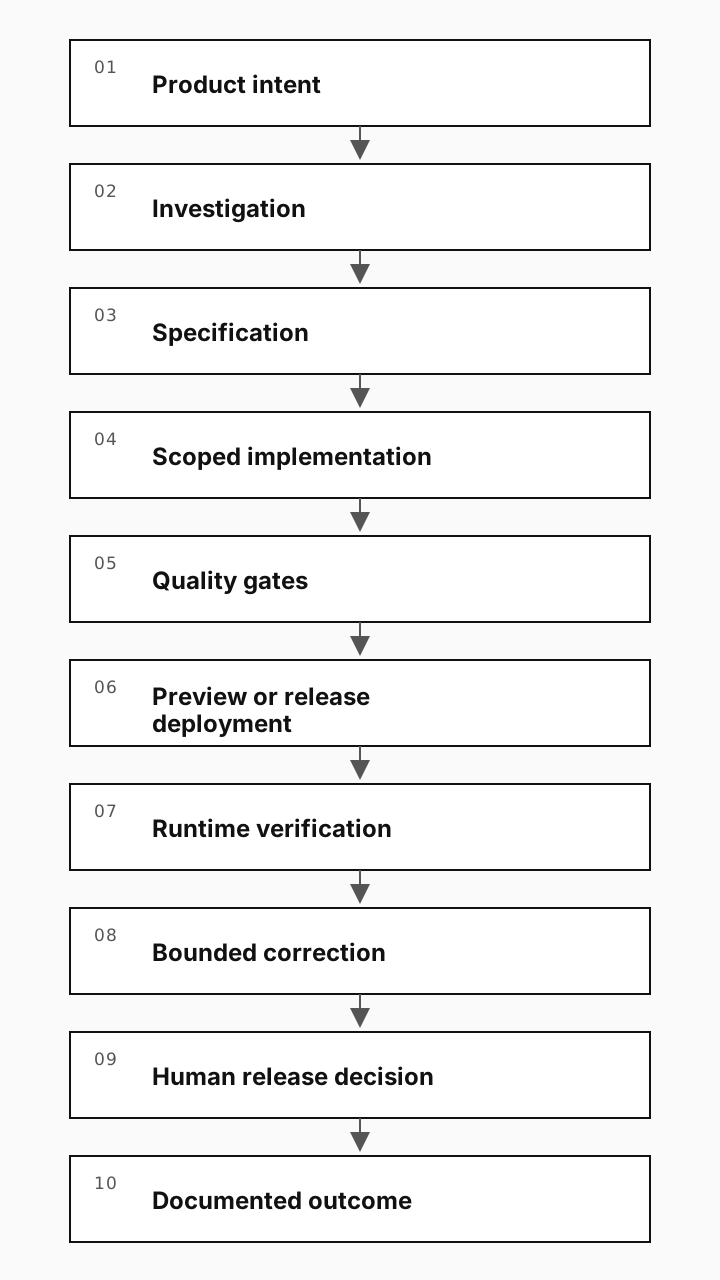
Authority model
The methodology defines what an agent may complete, what it must escalate, and which actions remain prohibited. The article explains the model; the matrix makes the operating boundary explicit.
| Activity | Agent authority | Human responsibility |
|---|---|---|
| Read code and investigate | Autonomous | Oversight |
| Clarify material ambiguity | Escalate | Decide |
| Implement approved scope | Autonomous | Review when needed |
| Run checks and previews | Autonomous | Oversight |
| Retry bounded failures | Autonomous within limit | Intervene after limit |
| Change authentication or schema | Propose only | Approve |
| Merge protected branches | Prepare only | Approve |
| Release production | Prepare and verify | Approve |
| Bypass verification | Prohibited | Prohibited |
| Expose secrets | Prohibited | Prohibited |
Methodology
The cornerstone note covers lifecycle, context, verification, bounded autonomy, correction, failure modes, and adoption stages.
Read Agentic Closed-Loop DevelopmentImplementation evidence
Ordr.now provides a concrete example of offline recovery, authorization boundaries, idempotent synchronization, and physical-device verification.
Read the Ordr.now proofWhat remains deterministic
What requires human judgment